On Boots

Foreword
It’s pretty peculiar to discuss about gear and equipment capable of responding to practicality, functionality and efficiency criteria in the event that an emergency situation arises caused by weather emergencies, environmental disasters, social unrest and so on.
However, a topic of fundamental importance remains massively underrated: footwear.
First things first, is necessary to discuss some basic considerations, discriminating between critical issues of a personal nature but also between different seasons, climates, altitudes and landforms.
On choosing the right footwear for the Great Outdoors: basic considerations
There is nothing more personal than choosing the right footwear that we would like to wear in a time of danger.
In fact, each of us has not only peculiar physical characteristics, but also distinctive elements that correspond to congenital or temporary disabilities, to the way of he/she walks which can mainly affect the heel or forefoot, the inside or the outside of the entire plant itself.
Our habits, the small – or big – pains that posture or our work have created for us therefore represent distinctive elements in the selection phase of the most suitable footwear for us.
However, there are fundamental requirements that should necessarily guide our choices:
- robustness
- reliability
- resistence
- versatility
Alongside these requirements, fit and comfort are absolutely essential.
In the event that, in fact, the shoes do not fit your feet perfectly, the risk of incurring a condition of discomfort or, at worst, of suffering from painful blisters and even capable of leading to infections remains very high.
You surely don’t want to become an issue to yourself or even to the party of people you are moving along.
Ultimately, it is necessary to underline that the aesthetic factor plays an essential role. If our mentality is accustomed – or in complete line – with solid and even aggressive footwear aesthetics, we will obviously consider them more suitable to carry out their task properly in a situation where every single step could make a difference.
Anatomical structure of footwear
Starting from the part adhered to the ground, and hypothetically continuing towards the ankle, we find:
1. Upper: The largest part of a shoe or boot that holds the foot up to the insole.
2. A rigid material is positioned immediately above the upper, sandwiched between the insole and the midsole. Referred to as a “shank,” and often made from nylon poly, it provides support and stability.
3. The rand (“rim”) is a strip of material (usually rubber) that wraps around the shoe where the midsole and upper meet; provides additional protection in difficult terrain.
4. Sole: it is the part in direct contact with the ground.
5. Midsole: The layer (usually some type of foam or ethyl vinyl acetate) that sits between the midsole and the outsole. It represents the most significant part of the shoe, as it determines the cushioning and shock absorption, ensuring general stability.
6. Insole: The thin material at the bottom of the inside of the shoe where the foot rests; for several years it has been made of ventilated material to ensure breathability.
7. Membrane: usually present in windproof and waterproof materials, breathable, it represents the part in which the rest of the foot and the ankle are wrapped.
Different materials, different applications
In recent decades, the evolution of the study of physical and chemical processes linked to weather conditions have led to the design of increasingly avant-garde materials.
New technology, in fact, led to the creations of some new typologies of foams, along with synthetic fabrics, rubber and, obviously, leather are used extensively to provide comfort, cushioning, support, protection and long – term durability.
Breathable waterproof membranes, such as Gore-Tex, provide a barrier from the elements through reduced pores to prevent water penetrating.
The different applications foreseen by a given shoe are not only linked to the specific characteristics of the shoe in question, but also to the design, the materials used and, above all, the needs that a particular situation can – and must! – dictate.
Substrate versus soil
Discriminating between urban and suburban areas, dominated by substrates such as concrete, asphalt, tar, cobblestones, tiles, and outdoor areas where instead earth, mud, sand are predominant, the type of terrain that everyone most commonly expects to encounter and the challenges dictated from it will greatly influence our selection of the most suitable footwear for a Bug Out Situation.
Seasons and climatic conditions
Not all footwear can adapt to the different seasons, as well as to altitudes and the relative morphology of the land. As a Mantracking Instructor (reading, identifying and following human footprints), I often find myself stressing this concept.
It is therefore necessary to carefully study the final destination as well as the entire journey that will lead us to it.
On a general level, some footwear particularly suitable for cold climates is badly suited for use in urban or suburban areas, on pain of short-term erosion of the tread that the sole presents. Conversely, some shoes designed for warmer climates cannot find a good application in areas above a thousand meters. The right compromise is possible, but always starting from a prior study of our itinerary.
My personal selection
This paragraph will only deal with the most suitable and versatile footwear for a Bug Out Situation context. The Italian market has a long manufacturing tradition that many countries envy us! Associated with each category, you will therefore find only a few of the multitude of tricolor proposals that can become your primary and secondary Bug Out footwear.
Trail shoes
I personally go for Merrell moab 2 mid gtx tactical.
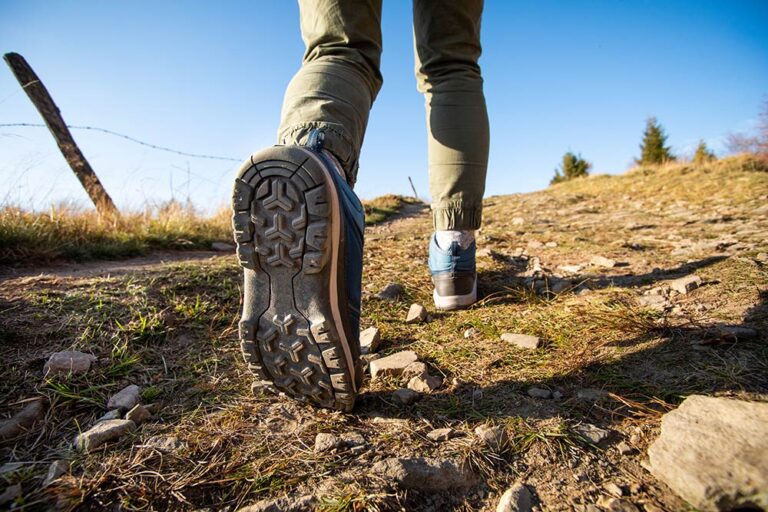
They can be considered a sort of very versatile hybrid shoe, lightweight as sneakers but with an excellent grip on the terrain.
I tested them several times on the craggy slopes of the Alps, and they never disappointed me.
Military boots & Hiking Boots
In this case my choice go to Police Patrol Boots 01 as well as to Military Protection Boots, both of them from the danish brand “2be Footwear”.
Needless to say that military boots have a more agressive and consistent design which is possible due to the employment of thicker, stronger and more reliable materials.
This is a garantee for durability, protection of your ankles as well as stability.
These kinds of boots are surely less comfortable for walking, but new technlogy managed to create the right balance between stability and flexibility, offering a good deal either with warm temperatures either with cold ones.
Military boots are supposed to protect yourself especially with extreme weather conditions, debris and harsh bushes.
Testing footwear: when and why and conclusions
Whichever type of footwear you choose, you need to take the appropriate time to break it in.
Synthetic and suede materials tend to require the least amount of testing, while leather takes significantly longer to adjust to our feet.
Only starting with short journeys up to longer itineraries (and several days), especially on varied terrain, with loads on the shoulders and with different weather conditions, will we actually be able to say we are satisfied with having chosen one or more totally reliable shoes in a Bug Out situation .
About The Author

Article by Kyt Lyn Walken. Official Representative and Instructor for Hull’s Tracking School and Certified Conservation Ranger for the NGO Conservation Rangers Operations Worldwide.
Recommended products

Leatherman Rev Multi-Tool
Pliers, knife, screwdrivers and more in one pocket-sized tool. A dependable everyday carry and home emergency kit essential.
View on Amazon
Blukar Rechargeable LED Camping Lantern
Bright, rechargeable lantern that lights a whole room during a blackout and doubles up for camping. Can also charge your phone.
View on Amazon
Ledlenser H8R Rechargeable Head Torch
Bright 600-lumen rechargeable head torch that keeps your hands free during power cuts, night walks and emergencies.
View on AmazonWe may earn a small commission if you buy through these links, at no extra cost to you. Learn more